
Q1 2026 Market Commentary
No Spring Break for Markets
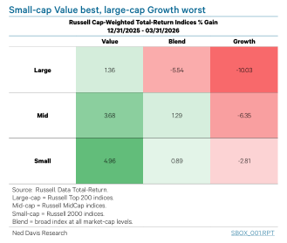
If investors were hoping for a quiet start to 2026, markets had other plans. While the first quarter finished lower across most major indices, a late-March rebound helped avoid what could have been the weakest start to a year since the pandemic.
The quarter was defined by a tug-of-war between resilient corporate earnings and mounting geopolitical pressures.
S&P 500: Declined -4.3%, marking its weakest quarterly performance since Q3 2022 as U.S. equities broadly moved lower.[1]
NASDAQ Composite: Experienced an intra-quarter drawdown of more than -12%, finishing down -6.9% as the AI related software selloff sparked tech-heavy turbulence.[2]
International Equities: After a strong initial start, the MSCI EAFE Index declined -3.2% as global growth concerns resurfaced.[3]
Bonds: The Bloomberg U.S. Aggregate Index finished roughly flat for the quarter, though it came under pressure late in the quarter, declining -4.0% in March as yields moved higher.[4]
The “Why” Behind the Volatility
Three primary forces shaped markets during the quarter:
1. Geopolitics & Energy Markets
Escalating tensions in the Middle East, particularly the critical shipping corridor in the Strait of Hormuz, drove a sharp rise in oil prices and reintroduced a geopolitical risk premium into markets. Higher energy prices act as a direct tax on consumers and businesses, but more importantly, they complicate the inflation outlook. The result is a more challenging policy backdrop, where central banks have less flexibility to respond to slowing growth.
2. The Evolution of the AI Theme
Investor enthusiasm around artificial intelligence appears to be entering a more mature phase, shifting from broad optimism toward a more disciplined focus on monetization, capital spending, and return on investment. This does not represent a breakdown of the AI theme; rather, as the cycle progresses, leadership will narrow and clear winners and losers will emerge.
3. The Fed’s Steady Hand
The Federal Reserve maintained a patient, data-dependent stance, holding its policy rate steady in a target range of 3.50%-3.75% while balancing moderating inflation against still-resilient economic activity. Markets entered the year anticipating a more aggressive easing cycle. Instead, policymakers have reinforced a “higher-for-longer” framework, prioritizing sustained progress toward their 2% inflation target. This recalibration in rate expectations has been a key contributor to both equity and fixed income volatility.
Where We Stand Today
Despite a challenging start to the year, markets showed resilience into quarter-end, supported by a still-solid economic foundation. More importantly, we believe markets are in the midst of a structural transition—from an environment driven primarily by liquidity and multiple expansion to one increasingly anchored in earnings durability, valuation discipline, and macro fundamentals.
This shift is unlikely to be linear. Periods of volatility are a natural byproduct and, historically, have created more attractive entry points for long-term investors.
At present, markets are balancing a complex mix of forces from concentrated leadership driven by AI-related enthusiasm to persistent geopolitical risks, early signs of stress in private credit, and re-emerging stagflation concerns. Rather than anchor on headlines, we remain focused on the underlying data:
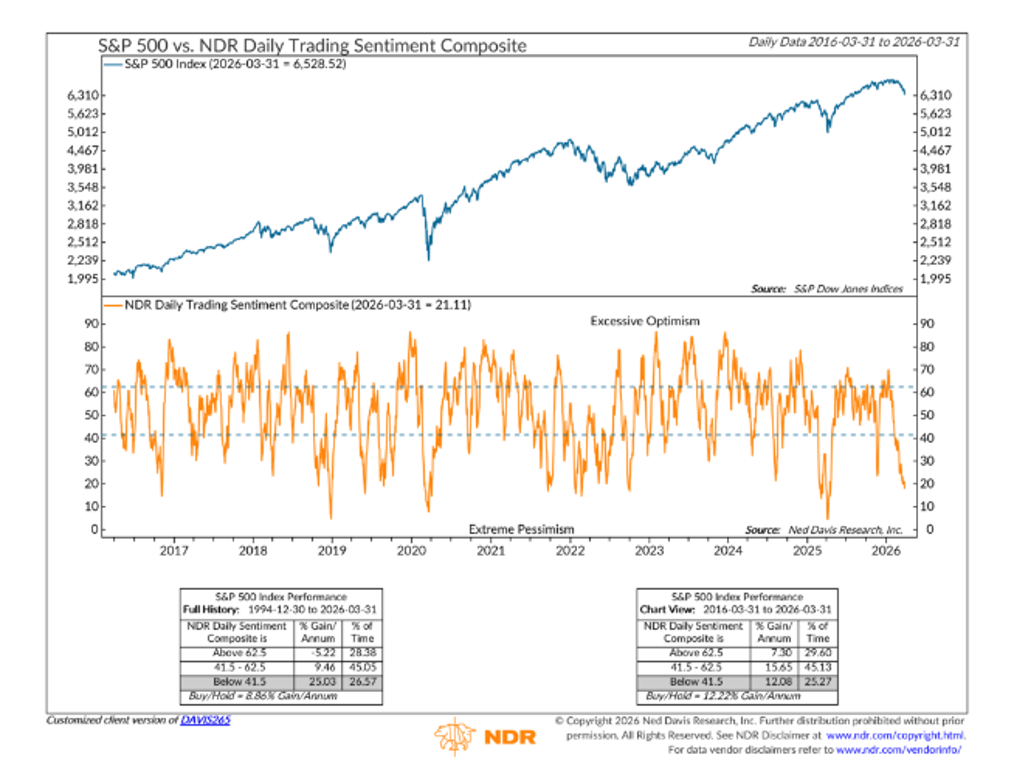
· Sentiment as a Signal: Investor sentiment deteriorated meaningfully during the quarter with the NDR Daily Trading Sentiment Composite falling below 25, its lowest level since November. Historically, such pessimism has served as a reliable contrarian indicator, in simple terms, when most investors are feeling negative and positioned defensively, markets often move in the opposite direction and produce stronger returns. We view recent geopolitical-driven weakness through that lens.
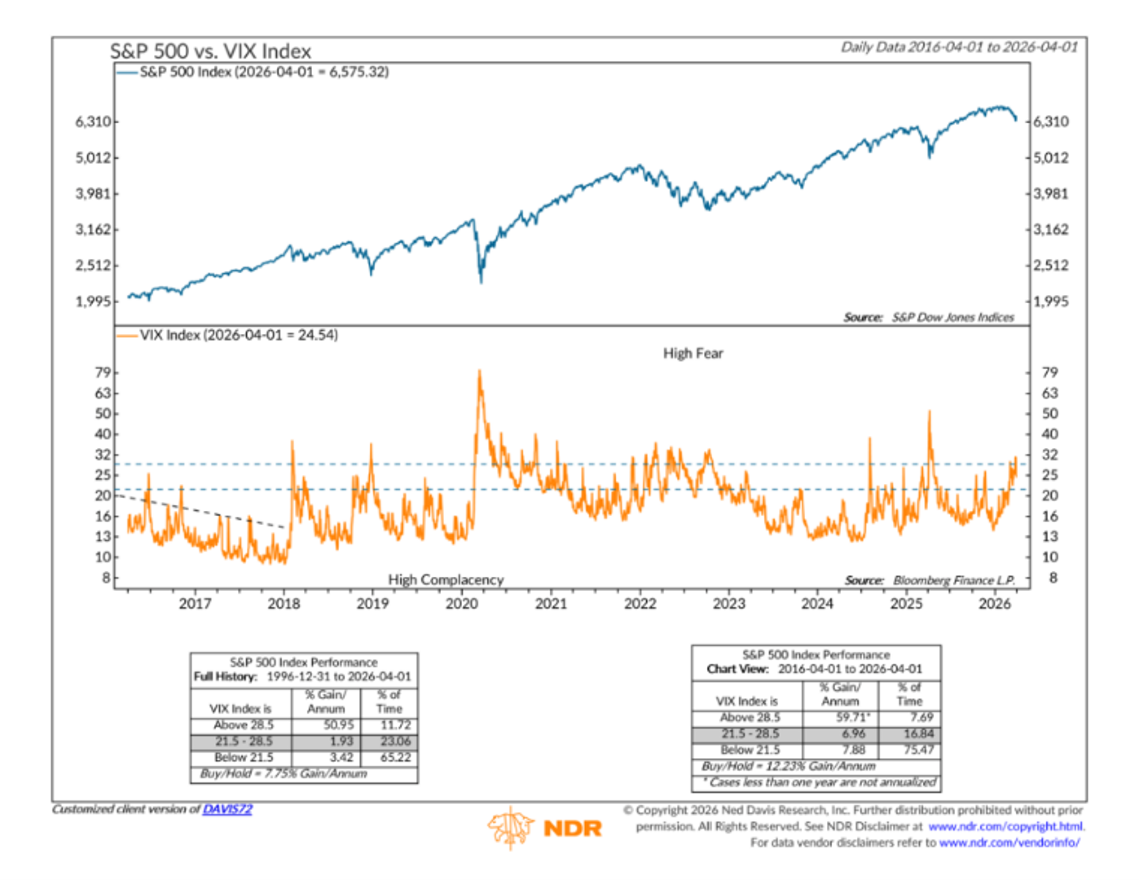
· Volatility Indicators: The VIX (CBOE Volatility Index) briefly reached 30, reflecting elevated uncertainty. While not indicative of full capitulation, these levels have historically aligned more closely with late-stage drawdowns rather than the start of new downturns.
· Earnings Resilience: Importantly, corporate fundamentals remain intact. Consensus estimates call for approximately 17% year-over-year growth in 2026, while the S&P 500 trades near 19–20x forward earnings, broadly in line with historical averages despite a meaningfully higher rate environment.[5]
Scenario Framework
· Bullish Case: A de-escalation in geopolitical tensions leads to easing energy prices and moderating inflation. In this environment, central banks gain flexibility to shift toward policy easing, supporting valuation expansion, broader market participation, and improved risk sentiment.
· Bearish Case: Geopolitical tensions remain elevated for a prolonged period, keeping energy prices higher for longer and increasing the risk of stagflation (the challenging environment of stagnant economic growth, elevated unemployment, and persistently high inflation). Under this scenario, earnings expectations would likely move lower, margins compress, and credit conditions would tighten, leading to continued market volatility.
Positioning and Outlook
As we enter Q2, the investment backdrop remains complex, with sentiment weighing on markets in the near term. Our base case assumes the current geopolitical tensions remain contained, limiting broader economic disruption. If that holds, we believe the recent deterioration in sentiment is cyclical rather than structural, and consistent with an intermediate-term market bottoming process. However, a more prolonged period of uncertainty would likely weigh further on both growth and market stability.
We maintain a modest overweight to equities, supported by:
Resilient earnings
Stabilizing economic growth
Secular tailwinds, including AI-driven productivity gains and a gradually improving regulatory backdrop
Within equities, we continue to favor U.S. markets, supported by innovation and profitability, while emphasizing broader diversification beyond mega-cap leadership. International equities remain an important complement, offering more attractive valuations, though they are likely to remain sensitive to energy-related shocks.
In fixed income, we retain a modest duration bias, positioning portfolios to benefit from a potential decline in rates should growth moderate. We continue to emphasize high-quality bonds and liquidity, as current credit spreads offer limited compensation for incremental risk.
Markets appear to be pricing in a backdrop of moderating growth alongside elevated, but contained, inflation. However, a shift toward a more pronounced stagflationary environment would likely trigger a rapid re-pricing of interest rate expectations. If growth concerns deepen while inflation remains sticky, the likelihood of renewed tightening increases—particularly as the Federal Reserve appears inclined to remain reactive rather than proactive amid ongoing uncertainty.
Final Thoughts
Our approach remains consistent: stay disciplined, remain diversified, and let data, not headlines, drive decisions. Periods of uncertainty can be uncomfortable, but they have historically created meaningful opportunities for long-term investors. We welcome your questions and look forward to discussing how this evolving environment impacts your specific portfolio.
[1] Morningstar Direct
[2] Morningstar Direct
[3] Morningstar Direct
[4] Morningstar Direct
[5] FactSet