
Q3 2026 Market Commentary
Strong Earnings, Narrower Leadership — Navigating a Higher-Rate Market
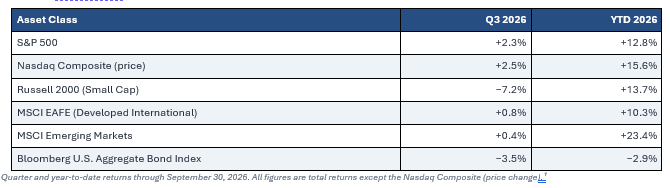
The third quarter illustrated how different the experience of investors can be from the performance of headline indexes. The S&P 500 advanced 2.3%, while small-cap stocks and core bonds declined as higher rates, renewed Middle East tensions, and shifts in market leadership tested confidence. After the broad recovery of the spring, gains became more selective.
At the same time, corporate earnings expectations continued to improve. Resilient profits remain an important support for equities, but higher financing costs and concentrated leadership leave less room for disappointment. We believe the appropriate response is disciplined portfolio construction, not attempts to anticipate every market rotation.
Markets at a Glance
A Market That Became More Selective
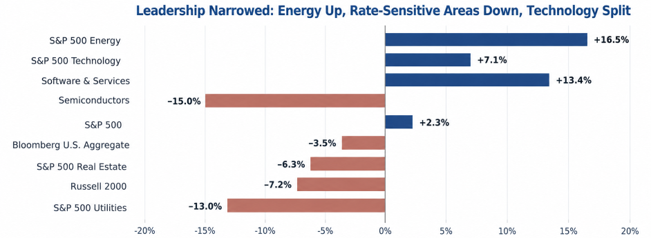
While the S&P 500 advanced modestly during the third quarter, gains were far less widespread than the headline index suggested. In contrast to Q2's broad rally, only four of the S&P 500's eleven sectors finished higher. Energy rebounded as oil prices rose, while smaller companies and interest-rate-sensitive sectors struggled. Even within technology, software and semiconductor stocks followed different paths.
For investors, this divergence reinforces the importance of looking beyond headline index returns. A portfolio can hold many investments yet remain exposed to the same underlying risks, such as AI capital spending or higher borrowing costs. Effective diversification means balancing exposure across different sectors, investment styles, and economic drivers rather than simply owning more securities.
Three Forces Shaping the Quarter
1. Earnings Continued to Surprise Positively
Corporate earnings remain the strongest support for equities. Third-quarter S&P 500 earnings are expected to grow 29.5% year-over-year, which would mark the third consecutive quarter of growth exceeding 25%. More notably, analysts raised earnings estimates by 1.4% during the quarter, compared with an average decline of 2.2% over the past five years. Corporate guidance has been equally encouraging, with 62% of companies providing positive earnings guidance, well above the 10-year average of 41%.³ These unusually strong indicators suggest corporate fundamentals remain resilient despite higher interest rates and economic uncertainty.
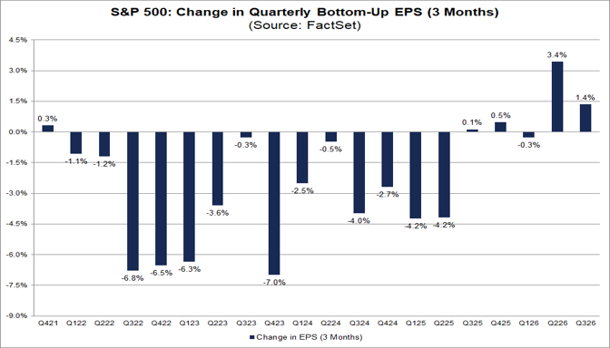
Even with rising stock prices, stronger earnings expectations brought valuations closer to historical averages. The S&P 500's forward price-to-earnings ratio declined from 20.4 at the end of June to 19.0 at quarter-end, slightly below its 10-year average of 19.1. While encouraging, this improvement still depends on companies delivering the substantial earnings growth investors anticipate.⁴
Artificial intelligence remains a powerful driver of growth, supporting demand for semiconductors, memory, networking, and data-center infrastructure. However, strong business growth does not always translate into equally strong stock returns. As investors look toward 2027, we expect greater scrutiny of profitability, cash generation, and the returns generated by substantial AI investments. We remain constructive on the long-term opportunity while emphasizing valuation discipline and diversification.
2. The Federal Reserve Raised the Cost of Capital
In September, the Federal Reserve raised its policy rate by a quarter percentage point to 3.75%–4.00%, its first increase since 2023. The 10-year Treasury yield reached 5.29% at quarter-end, up from 4.44% in June, pressuring bond prices and companies sensitive to borrowing costs.5
The economy nevertheless continued to expand, supported by consumer spending and business investment. Hiring has moderated, but slower growth has not become a broad contraction. With inflation still above the Fed’s 2% target and energy prices rising again, portfolios should not depend on imminent rate cuts. Companies with durable cash flows and manageable debt are better positioned to absorb higher borrowing costs.
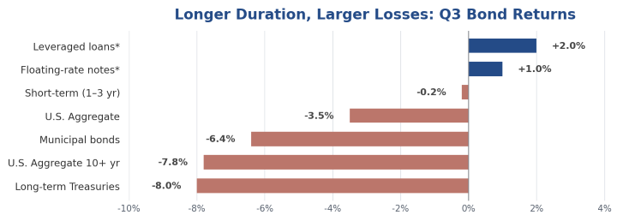
For bond investors, rising rates create both challenges and opportunities. Longer-duration securities experienced the greatest price declines, while short-term and floating-rate debt held up better. Higher starting yields have also restored meaningful income, and at current levels, bonds play a renewed diversifying and defensive role in portfolios looking forward. We continue to favor high-quality bonds with moderate duration, balancing attractive income against further rate volatility.
3. Energy Prices Reintroduced Inflation Risk
Renewed tensions involving Iran and the Strait of Hormuz revived concern about global energy supplies. West Texas Intermediate crude rose approximately 30% during Q3, reversing much of its second-quarter decline.7
Higher fuel, freight, and operating costs can pressure consumers and corporate margins while complicating the Fed’s inflation outlook. Rather than positioning portfolios around a geopolitical forecast, we focus on resilient businesses and liquidity appropriate to each client’s needs.
International Markets: Diversification by Risk Driver
International returns were uneven. Developed-market equities posted modest gains, while emerging markets were approximately flat following a strong first half. Exposure to Asian semiconductor supply chains generated some of the same volatility affecting U.S. technology stocks.8 Geographic diversification matters, but it is more valuable when it adds different industries, currencies, valuations, and earnings drivers rather than duplicating the same AI-related risks.
Outlook and Portfolio Positioning
Our outlook entering Q4 remains constructive, though increasingly selective. We maintain a modest equity overweight, supported by resilient earnings and a still-expanding economy. Higher rates and concentrated leadership reinforce our preference for profitable businesses, healthy balance sheets, sustainable cash flows, and valuations supported by realistic earnings expectations.
Equities. We retain exposure across market capitalizations, including mid- and small-cap stocks despite their recent weakness. Within technology and other sectors, we emphasize durable earnings rather than concentration in the market’s most crowded themes.
International equities. We continue to hold international investments that offer different economic and currency exposures, rather than simply repeating U.S. technology risk in another market.
Fixed income. With the 10-year Treasury yield near 5.3% at quarter-end, its highest level since 2002, high-quality bonds offer some of the most attractive income opportunities in more than two decades. We seek to appropriately rebalance portfolios and redeploy excess cash thoughtfully into high-quality fixed income while maintaining moderate duration to manage interest-rate volatility.
Year-end planning. The quarter’s uneven returns create opportunities for selective rebalancing and tax-loss harvesting in taxable portfolios. We assess these changes in the context of each client’s liquidity needs, tax circumstances, and long-term objectives.
Looking ahead, we are closely monitoring whether earnings strength broadens beyond a relatively small group of companies, whether long-term yields stabilize, and whether energy costs place renewed pressure on inflation.
Investor Takeaways
· Earnings remain supportive. Exceptional profit growth underpins equities, but sustaining it will matter as expectations rise.
· Quality matters more. Higher borrowing costs favor resilient balance sheets, durable earnings, and cash flows.
· Diversification goes beyond geography. Investments across different countries can still be driven by the same underlying theme, reinforcing the importance of diversifying across distinct sources of risk and return.
· Volatility creates opportunity. Disciplined rebalancing, attractive bond yields, and tax-loss harvesting can help improve long-term portfolio outcomes.
Final Thoughts
The third quarter reinforced that strong corporate earnings do not necessarily translate into equally strong investment returns. As leadership changes and the economic backdrop evolves, disciplined diversification and thoughtful risk management become even more valuable.
Our focus remains on high-quality investments and portfolio decisions that support the long-term preservation and growth of our clients’ wealth. Thank you for the confidence you place in our team. We welcome the opportunity to discuss how today’s market environment and your portfolio positioning fit within your long-term financial plan.
Source Footnotes
1. USI Consulting Group (Sept. 2026); Cramer Rosenthal McGlynn, Russell 2000 performance.
2. Broad-market/sector returns: Patient Capital Management, “3Q26 Quarterly Market Review” (Oct. 1, 2026), citing Bloomberg; USI Consulting Group. Software & Services and Semiconductors: S&P Select Industry Index total returns reported by State Street (XSW, XSD).
3. FactSet, John Butters, “S&P 500 Earnings Season Preview: Q3 2026” (Oct. 2, 2026); FactSet, “Record-High Number of S&P 500 Companies Issuing Positive EPS Guidance for Q3” (Oct. 5, 2026).
4. FactSet, John Butters, “S&P 500 Earnings Season Preview: Q3 2026” (Oct. 2, 2026), forward P/E ratios.
5. Federal Reserve, FOMC Statement (Sept. 16, 2026); U.S. Treasury, Daily Treasury Par Yield Curve Rates (June and Sept. 2026).
6. Ned Davis Research, Q3 2026 Benchmark Review; Bloomberg fixed-income indices; USI Consulting Group (Sept. 2026).
7. Patient Capital Management, “3Q26 Quarterly Market Review” (Oct. 1, 2026), reporting Q3 WTI crude oil price movement.
8. USI Consulting Group, “September 2026 Market & Legal Update”; Clearstead, “Quarterly Market Insights | 3Q26” (Oct. 2026).
DISCLOSURES
IMPORTANT DISCLOSURE INFORMATION
This material is provided for informational purposes only and should not be construed as a recommendation or investment advice, as the material does not consider the investment objectives, risk tolerance, restrictions, liquidity needs or other characteristics of any one particular investor. All information has been obtained from sources believed to be reliable, but its accuracy is not guaranteed. The views expressed in this commentary are subject to change based on market and other conditions. These documents may contain certain statements that may be deemed forward-looking statements. Please note that any such statements are not guarantees of any future performance and actual results or developments may differ materially from those projected. Any projections, market outlooks, or estimates are based upon certain assumptions and should not be construed as indicative of actual events that will occur.
Please note that nothing in this content should be construed as an offer to sell or the solicitation of an offer to purchase an interest in any security or separate account. Nothing is intended to be, and you should not consider anything to be direct investment, accounting, tax or legal advice to any one investor. Consult with an accountant or attorney regarding individual accounting, tax or legal advice. No advice may be rendered unless a client service agreement is in place.
No investment strategy or risk management technique can guarantee returns or eliminate risk in any market environment. All investments include a risk of loss that clients should be prepared to bear. Different types of investments involve varying degrees of risk and there can be no assurance that any specific investment will either be suitable or profitable for a client’s investment portfolio. Economic factors, market conditions and investment strategies will affect the performance of any portfolio, and there are no assurances that it will match or outperform any benchmark. Asset Allocation may be used in an effort to manage risk and enhance returns. It does not, however, guarantee a profit or protect against loss.
New World Advisors, LLC ("New World") is a Registered Investment Advisor ("RIA") with the U.S. Securities and Exchange Commission (“SEC”). New World provides investment advisory and related services to clients nationally. New World will maintain all applicable notice filings, registrations and licenses as required by the SEC and various state regulators in which New World conducts business. New World renders individualized responses to persons in a particular state only after complying with all regulatory requirements or pursuant to an applicable state exemption or exclusion.