
Q2 2026 Market Commentary
From War Premium to Wall Street Rally — Why Diversification Matters Again
The second quarter of 2026 was a powerful reminder that markets rarely wait for uncertainty to disappear before moving higher. Just three months after posting its weakest quarter in four years, the S&P 500 rebounded 14.9%, its strongest quarterly gain since 2020, as investors looked beyond geopolitical conflict and refocused on resilient corporate earnings, accelerating investment in artificial intelligence (AI), and an economy that proved more durable than expected.¹
The rally was fueled by easing tensions in the Middle East, stronger-than-expected earnings, resilient economic data, and a Federal Reserve increasingly focused on inflation. Not all the tailwinds are likely to remain equally supportive during the second half of the year. Most strategists view better-than-expected economic data as the least likely to continue surprising to the upside. Encouragingly, recession risks remain relatively low, supporting our constructive outlook for the broader market.
The most important takeaway, however, was not simply how much markets gained but how quickly leadership changed. International equities, small-cap stocks, and cyclical sectors joined technology in the advance, even as performance remained concentrated in several AI-related areas. That evolving leadership reinforces one of investing’s most enduring principles: well-diversified portfolios are better positioned to navigate changing market environments than portfolios built around a single theme or recent winner.
Markets at a Glance
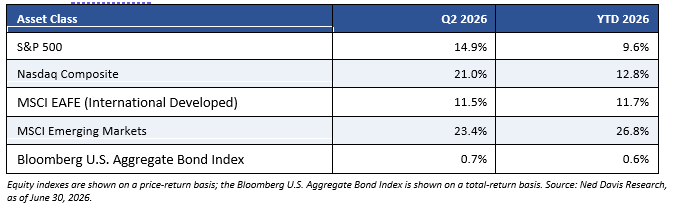
A Strong Recovery and an Important Reminder
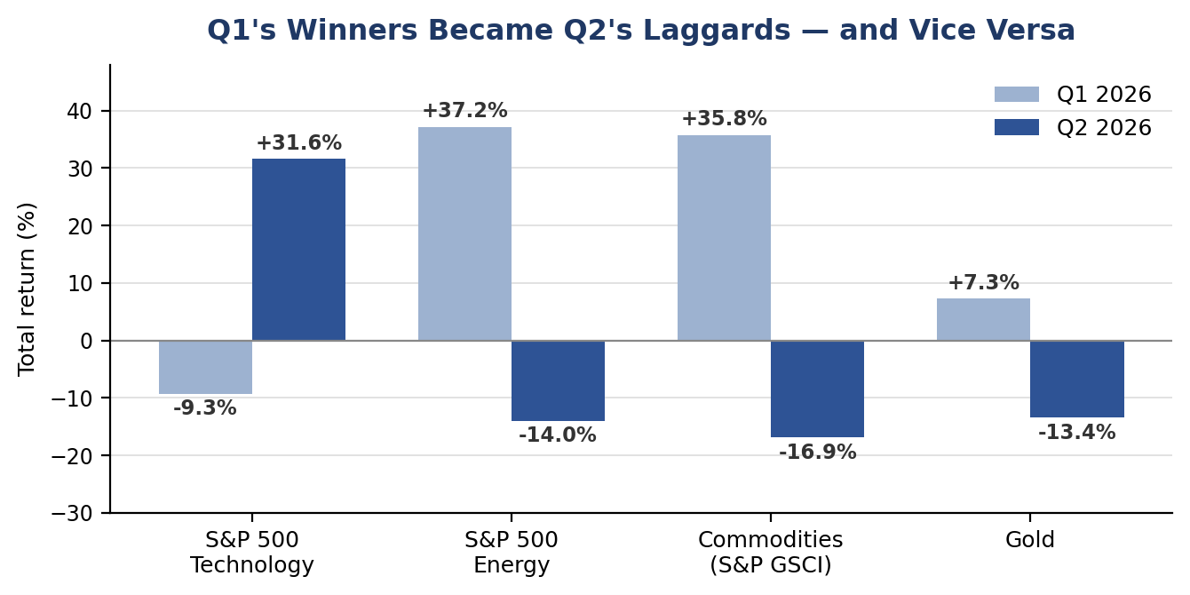
Beneath the impressive headline returns, the market told a more nuanced story. A relatively small group of companies continued to account for a disproportionate share of index gains, even as leadership shifted dramatically from the first quarter. Energy and defensive assets gave way to technology, semiconductors, and small-cap stocks, while the gap between winners and losers widened. For long-term investors, this is precisely the type of environment in which diversification adds value, allowing portfolios to participate as leadership evolves rather than relying on any single sector or investment theme.¹
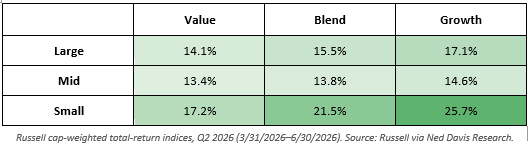
The broadening wasn't limited to sectors. All nine Russell style boxes gained at least 13% during the quarter for the first time since 2009 with small-cap stocks leading across every investment style.¹ While market leadership remained more concentrated than historical norms, participation expanded meaningfully, providing encouraging evidence that the rally was becoming less dependent on a handful of mega-cap companies.
Three Forces Behind the Rally
1. Corporate Earnings Lead the Story
Earnings remain the market's primary engine. Consensus estimates call for roughly 24% S&P 500 earnings growth in 2026, a pace rarely seen outside of a post-recession recovery, and analysts continued raising earnings estimates throughout the quarter.² Much of that strength remains concentrated in technology and semiconductors, which accounted for more than six percentage points of the market's roughly 10% first-half gain.³
At approximately 20 times forward earnings, current valuations appear reasonable if this level of earnings growth persists, but they leave less room for disappointment. As investors begin looking toward 2027, the question will shift from whether earnings are strong to whether they are sustainable. AI remains one of the market's most compelling long-term investment themes, but we believe it should complement, not dominate, a diversified portfolio.
2. Geopolitical Risks Eased — But Haven't Disappeared
As the Strait of Hormuz reopened and fears of a prolonged energy shock faded, oil prices retreated and the “war premium” embedded in markets unwound. Energy went from Q1's best sector to Q2's worst. Tensions have flared again since quarter-end, a reminder the story isn't over, but markets once again demonstrated their tendency to recover well before uncertainty fully resolves. We view geopolitics as a source of short-term volatility, not a reason to change long-term plans.
3. The Fed Has Shifted the Conversation
Investors entered 2026 expecting multiple Federal Reserve rate cuts. By quarter-end, persistent inflation, a resilient economy, and new Federal Reserve leadership focused squarely on price stability had shifted expectations toward a higher-for-longer interest-rate environment. Today, the bond market is pricing in the possibility of one to two rate hikes before year-end rather than the rate cuts anticipated at the beginning of the year.⁵
Recent economic data suggest the economy is gradually cooling, but not contracting. The June employment report showed hiring slowing more than expected, while the decline in the unemployment rate reflected lower labor force participation rather than stronger job creation. Although one month's data does not establish a trend, it reinforces our view that economic growth is moderating after several years of exceptional resilience rather than moving toward recession.⁶
For investors, the implications are straightforward. Higher interest rates may contribute to periods of market volatility, but they have not derailed corporate earnings or economic activity. Instead, today's environment reinforces the importance of building portfolios that can perform across a range of economic and interest-rate scenarios rather than relying on a single outcome.
Diversification Extended Beyond the U.S.
International markets delivered some of their strongest returns in years. The Eurozone posted its best quarter since 2020 and reached a record high in June, supported by lower energy prices and improving investor sentiment. Japan continued to benefit from strengthening corporate fundamentals, while emerging markets led global returns, driven largely by semiconductor-heavy Taiwan and South Korea.⁷
The headline performance, however, masks an important distinction. Much of the international rally was powered by the same AI and semiconductor themes that drove U.S. markets, while many other countries produced more modest returns. For investors, the lesson is clear: true diversification extends beyond geography. Building resilient portfolios requires exposure across regions, sectors, investment styles, and return drivers.
Higher Yields Continue to Improve the Case for Bonds
Quietly, fixed income became more attractive. The 10-year Treasury ended the quarter near 4.4% and moved above 4.6% in early July, extending the longest bond bear market on record, dating to August 2020.8 Higher yields have weighed on prices, but they have also restored something investors have not enjoyed in years: meaningful income. For clients holding excess cash or underweight bonds, today’s yields represent one of the most compelling entry points in years. We continue to favor high-quality bonds for income, stability, and diversification.
Outlook and Positioning
The market enters the second half of the year from a position of strength, but with higher expectations. Long-term breadth remains constructive, with roughly 61% of U.S. stocks trading above their 200-day moving averages. At the same time, the index stands about 8.8% above its own long-term trend, suggesting that a period of consolidation following the spring rally would be both normal and healthy.¹,⁹
History also provides useful perspective. Following quarterly gains of more than 12%, the S&P 500 has risen over the subsequent two quarters 75% of the time, with a median gain of 10.1%. When those strong quarters occurred in Q2, the median return from July through December was 12.2%, with only two negative second halves since 1927.¹ While history is not a forecast, strong momentum alone has rarely signaled the end of a bull market.

We maintain a modest overweight to equities, supported by resilient earnings and a relatively low probability of recession. However, higher valuations reinforce the importance of disciplined portfolio construction rather than chasing recent winners.
In practice, that means maintaining meaningful exposure beyond the largest technology companies, including mid- and small-cap stocks and strategies positioned to benefit if market participation continues to broaden. Within technology, we favor quality, profitability, and durable earnings over concentration in the market’s hottest AI-related names. We also continue to view international equities as a valuable complement, while recognizing that much of their recent strength has been driven by the same semiconductor and AI themes supporting U.S. markets.
Within fixed income, today's higher yields present one of the most attractive opportunities in years to redeploy excess cash into high-quality bonds. Higher rates have restored meaningful income, making high-quality bonds attractive once again for income, diversification, and long-term return potential. We continue to favor high-quality bonds with moderate duration given the potential for a higher-for-longer interest-rate environment. More broadly, we believe the second half is likely to reward balanced, well-diversified portfolios.
Investor Takeaways
Diversification matters again. Broader participation is creating opportunities beyond the largest technology companies while helping reduce reliance on any single investment theme.
Earnings remain the foundation. Corporate profit growth, not short-term headlines, will likely determine the market’s direction from here.
Bonds are attractive again. Higher yields allow investors to earn meaningful income from high-quality fixed income while improving portfolio diversification.
Stay disciplined. Following a strong rally, periods of consolidation would be normal and healthy. History suggests they are often part of an ongoing market advance rather than the end of one.
Final Thoughts
The second quarter reinforced how quickly market leadership can change. Rather than attempting to predict the next headline or chase the market’s latest winners, we remain focused on building balanced portfolios grounded in high-quality investments, disciplined risk management, and long-term fundamentals.
Thank you for the confidence you place in our team. As always, we welcome the opportunity to discuss how today's market environment, and your portfolio positioning, fit within your long-term financial plan.